
-
The curse of confusion: why thinking is bad for singing
Listed on July 6, 2015 by Chris Rowbury in Blogs!I teach a song by ear in less than an hour at a workshop. Everyone picks it up really quickly and then they sing it brilliantly.
We’ve been working on the same song with my very accomplished weekly choir for quite some time. They really struggle and it’s like plodding through mud. What’s going on here? It’s all about your head getting in the way.no time to worry
Twice a year I create a choir from scratch in just six two-hour rehearsals (see Instant choir – just add people). There are no auditions and everyone is welcome. We tackle eight or more songs, all taught by ear and all in four-part harmony.
The project goes at breakneck speed: people lap up the songs, nail their parts, learn the (often foreign) words, have fun and then perform to a high standard.
When it’s all over the singers often realise that some of the songs were quite hard and they’ve learnt a huge amount in a really short time.
There has been no time or space for people to think: what’s the next word? do I really know verse two? does it go up at the end of the line or down?doubt creeps in week by week
I teach a song to my weekly choir and they pick it up really quickly. We sing it through at the end of the rehearsal and it sounds fantastic. Maybe a few tweaks are needed here and there, but we’ll go over it the following week and it should be fine.
The next week comes. We go over the song and it’s awful. Nobody seems to remember their part. Sections stumble and come to a halt. Frowns appear and singers look at each other questioningly. Confusion reigns.
The fact that we have plenty of time to work on a song means that there is ample scope for people to think: how many times do we repeat the second section? do the altos come in at the start or only the second verse? what if my voice cracks when I go for that high note?the virus of doubt
I’m used to seeing frowns on singers’ faces (see Why the singers in your choir still love you even though they look bored), but when people start to shoot desperate glances at each other and some singers just stop singing, I know there is something wrong.
Often a whole section can become infected with the virus of doubt. A miasma of confusion hangs over their heads like a thick cloud. Once doubt has infected a part it’s very hard to instil confidence again.
When there is time to think, there is space created for doubt. None of us is ever 100% sure of what we’re doing, but given time, doubts build upon doubts and things just get worse.
You might be a bit hesitant about your part. You sing quietly and hesitantly then suddenly realise the singer next to you is singing something slightly different. You glance at them quickly in confusion.
You’re doing quite well, but suddenly the singer next to you glances at you looking very confused. Maybe you’ve done something wrong? Maybe you’re singing your part incorrectly and so you begin to wonder that you don’t know it as well as you thought. You start to sing quietly and hesitantly, very aware of the singer next to you.
You notice that all the singers around you are singing more quietly and rather hesitantly. Maybe you missed the conductor’s instruction or maybe nobody in your section really knows their part. You don’t want to be the odd one out, so you too start to sing more quietly and begin to doubt whether you actually know what you’re doing.
Slowly a whole section can grind to a halt and begin to doubt that they ever knew the song in the first place. Peer pressure and time for thought has allowed the virus of doubt to spread.behave as if you know what you’re doing
What can you do about this? Is it possible to avoid falling into the doubt trap?
Yes.
It’s not enough just to tell people to stop thinking too much, but it is possible to encourage people to have more trust (see also Four powerful ideas guaranteed to help you learn to sing better).
Trust that they know more than they think; trust that they’re perfectly capable of singing the song; trust that making a mistake doesn’t mean the end of the world; trust in your fellow singers; trust that your choir leader will help (see also Trust me – you know it makes sense).
Given that trust, you then simply have to behave as if you know what you’re doing (because 99.9% of the time you do) and everything will be fine (see also Two big ideas to create the perfect choir or singing experience).
Don’t think, just sing!Chris Rowbury
Website: chrisrowbury.com
Facebook: Facebook.com/ChrisRowbury
Twitter: Twitter.com/ChrisRowbury
Monthly Music Roundup: Tinyletter.com/ChrisRowburyRead more ...
-
Chris Rowbury’s monthly music roundup
Listed on June 30, 2015 by Chris Rowbury in Blogs!I thought you might be interested in a new venture of mine.
I’m about to publish a free, monthly roundup of music news delivered straight to your inbox.
As those of you who follow my Facebook Page know, I regularly post interesting videos, articles, photos and jokes about all things musical, choral, vocal and singing-related (no cat videos!).
But the famous Facebook algorithm means that most people who ‘like’ my page get to see very little of what I post.
So I've decided to make it more widely available by publishing a monthly roundup that you can subscribe to by email.
The first issue will be out on 1st July 2015 and every month thereafter. Who knows, if people like it I may even go to a weekly publication.
If you want to try it out, then you just sign up here: tinyletter.com/chrisrowbury I only need an email address. Simple!
You can, of course, unsubscribe at any time.
[This is not to be confused with my singing workshop mailing list. If you sign up for that you will get two newsletters a year to let you know what I’ve been up to and what singing workshops I’ve got coming up. You can see the latest summer edition here: Summer singing news and if you like what you see you can sign up to my mailing list.]Chris Rowbury
Website: chrisrowbury.com
Facebook: Facebook.com/ChrisRowbury
Twitter: Twitter.com/ChrisRowbury
Monthly Music Roundup: Tinyletter.com/ChrisRowburyRead more ...
-
How to pace a long singing workshop effectively
Listed on June 29, 2015 by Chris Rowbury in Blogs!If a singing workshop is just a couple of hours long, then singers’ energy and concentration will probably be fine.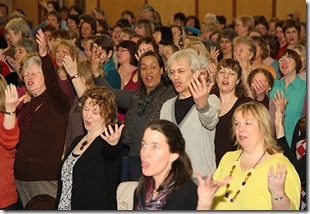
But for workshops which last a whole day, energy, concentration, focus, boredom, etc. all become factors. What’s the most effective way to pace a long singing workshop?grab ’em while they’re fresh
Energy and enthusiasm (and trepidation!) are at their peak when a workshop starts. Take advantage of this to put the group through their paces (lots of pitching and harmonising exercises and fun singing games) and maximise teaching time while energy levels are up. Start with an easy song, but then try to tackle harder material while everyone is fresh.you need breaks, but ...
You’ll need to break up the workshop to give people time to rest, go to the toilet and grab a drink. But you need to plan carefully. If, for example, you have 40 singers and each one takes a minute to get a cup of tea, that’s 40 minutes gone before you realise it. And if you say a break is going to be 10 minutes long, you can be sure that it will become 15 or even 20 minutes. So factor this in.
On a one-day singing workshop I never have a formal tea break in the morning, just a 10 minute “wee and water” break. We then have a longer, more formal tea break in the afternoon when people are flagging.have seats, but don’t use them all the time
It’s best if people stand when singing. But people will get tired when they’ve been on their feet for a long time. Make it clear that people can sit down whenever they need to, but every now and then get everyone up to sing through an entire song. Variety keeps energy up.
Make sure you teach the harmonies to each song in small chunks so no one section is waiting around too long. If you DO have a tricky part to teach, make it clear that other sections can sit down while they wait.how to deal with the post-lunch slump
After lunch, singers will have forgotten everything they’ve learnt so far! They will have no recollection of the songs they learnt in the morning, their brains will have turned to mush and they will have very little capacity to learn anything new.
I try to limit all the teaching to the morning session. If I do teach anything after lunch, I make sure it’s not too hard. I start the afternoon session with some energising or “brain gym” exercises. I then go at a much slower pace and don’t get impatient when I have to go over and over things. Singers will need a lot of reminding, so make sure you leave plenty of time.leave time for revision (and singing)
At the end of a long workshop it’s important to revise everything. People have come to sing, not to learn all the time, so make sure you leave plenty of time to sing through all the songs you’ve taught. Participants will want to feel a sense of accomplishment, that they’re really nailed a song and that it’s bedded in.
Recent research has shown that revising something just at the point of forgetting helps to establish it in long term memory. Revising all the songs at the end has this effect. People will just be on the verge of forgetting what they learnt at the start of the day, so it’s a great time to run through it again so it will stay with themwhat’s your experience?
How do you find the pace of one-day singing workshops? If you’re a workshop leader, do you have any other useful suggestions for pacing the day? And if you attend workshops, how do you find the longer ones? I’d love to hear from you. Do drop by and leave a comment.Chris Rowbury
Website: chrisrowbury.com
Facebook: Facebook.com/ChrisRowbury
Twitter: Twitter.com/ChrisRowbury
Read more ...
-
Martine Bailey’s Arvon Week
Listed on June 22, 2015 by Arvon in Blogs!Martine Bailey Blogs about Persistence and the Road to Publication. My Arvon week was nearly twenty years ago,...
The post Martine Bailey’s Arvon Week appeared first on Arvon.
Read more ... -
Have you got what it takes to be a singer?
Listed on June 22, 2015 by Chris Rowbury in Blogs!There’s a lot of nonsense out there about what it takes to be a singer.
The fact is, you already are one! Let’s unpick some of the myths and misconceptions.what does it take to be a singer?
I believe that everyone can sing.
“Hold on a minute! What about my Uncle Bob? He can’t hold a tune to save his life!”
This is my response to that: “Everyone can sing” – What the hell does that mean??!!
A lot of people will say that you don’t have what it takes to be a singer if you haven’t got natural talent or you don’t have a hit record or you haven’t had singing lessons or you don’t put the work in.
But for every comment like this there is always an example that contradicts it.
There are plenty of well-known successful singers who don’t have “nice voices”. There are thousands upon thousands of the most beautiful singers out there who you will never hear of because they aren’t famous. For every great singer who has taken loads of singing lessons and put the long hours in, there are those who just came into the world with an amazing voice and didn’t have to work at it.
Most people who worry about being a ‘good’ singer or need to know if they have what it takes are out to be famous. They want to be a big success and become a celebrity with millions of record sales.
But that has nothing to do with singing. That’s about being famous which is a whole other story. It’s about people who need the validation of the world to feel good about themselves.you’ve already got what it takes
If you’re worried that you don’t have what it takes to be a singer, you might want to check out these articles.
Is how you label yourself as a singer holding you back? – you might have put yourself in the wrong box or have an out-of-date view of yourself. Time to change that!
Want to sing but are scared of being judged? Here’s what to do – everyone can sing and you have an amazing, unique voice, but may be nervous about sharing it. Here are some hints to get you started.
If not now, when? – start singing NOW! – this is for you if you’ve always put off singing until tomorrow, or until that day when you feel ‘ready’
Never let the fake perfection of pop singers put you off singing – many of you compare yourselves with your favourite pop singer and find yourself lacking. But most modern pop songs have Autotune and many other tricks to make the singers sound better than they really are.
How do you get to the truth of what your singing ability really is? – here are some ways of finding out what you really sound like as opposed to what you think you sound like.
What makes a ‘good’ singer? – it’s all about context – ‘good’ depends on whether you’re going to make a recording to sell or if you just want to sing to your friends.
Never tell someone they can’t sing – it is brutal, damaging and untrue – you may well have been put off singing by someone’s casual remark on your singing ability. So be careful what you say to others – it can hurt and last a lifetime.
One unkind word can put you off singing for ever – how to protect yourself – and if someone has made nasty comments about your singing, here are some ways get over it.
Be the best singer you can, but don’t forget there’s more to life – we all want to be great singers, but don’t get fixated on the fame thing, find a balance to your life.
What to do if you don’t have a ‘nice’ voice – it’s not up to you to decide whether your voice is ‘nice’ or not, and remember one person’s ‘nice’ is another’s ‘terrible’!
Singing the wrong note is not the end of the world – we can be very hard on ourselves and maybe even want to give up if we’re less than perfect, but it’s inevitable that we’ll make mistakes as we develop.
The only thing stopping you from being a better singer is ... you! Get your head out of the way and let your singing voice do its job.
Your singing voice: if it ain’t broke, don’t fix it! – if everything’s going well, you like the sound of your voice and it never becomes hoarse, then you don’t need singing lessons. Just sing!
Can I call myself a ‘singer’? – all those preconceptions about what it takes to be a ‘real’ singer just get in the way of us singing and thinking of ourselves as singers.
Putting the hours in – are singers born or made? – you may have heard that to be an expert at something you need to put in 10,000 hours of practice. But maybe you’ve either got it or you ain’t. What do you think?
How to be a confident singer – easy: stop caring what other people think about you!
Learning to love the sound of your own voice – weird isn’t it that most of us hate how we sound when we listen to a recording of our own voice? You can get over this though.
Why can’t I sing? – a list of many of the (false) reasons why people think they can’t sing and some useful counter-examples.
How do I know if I’m singing in tune? – and when you’ve figured that out, you can go on to Learn how to sing in tuneChris Rowbury
Website: chrisrowbury.com
Facebook: Facebook.com/ChrisRowbury
Twitter: Twitter.com/ChrisRowbury
Read more ...
-
A Half Term of Writing – St. Benedict School at Totleigh Barton
Listed on June 16, 2015 by Arvon in Blogs!Rachel Hursey, Head of English, St Benedict’s Catholic High School, Alcester Whilst most teachers might look forward to...
The post A Half Term of Writing – St. Benedict School at Totleigh Barton appeared first on Arvon.
Read more ... -
Choir and workshop leaders: make sure you’re on the receiving end from time to time
Listed on June 15, 2015 by Chris Rowbury in Blogs!I like being in charge, as do most choir and singing workshop leaders. Our job mainly consists of telling people what to do and helping them to sing the best that they can.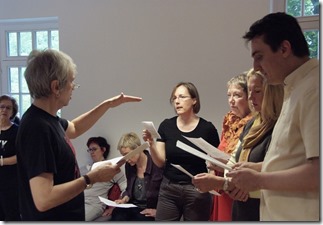
Trouble is it’s easy to forget what it’s like to be on the receiving end of that. Which is why I always try to attend other singing workshops as a normal participant.
We plan every choir rehearsal or singing workshop carefully: we are in control, we know what’s going to happen next, and if we’re lucky we get good results. We try hard to empathise with our singers and use our skills to help them in the best way we can.
But sometimes we forget what it’s like to struggle to learn by ear, or to wrestle with foreign lyrics, or to listen really hard to nail a tricky harmony, or not to chat whilst other sections are learning their part, or to be a stranger in a large group.
The only way to really understand what it’s like to be one of your singers is to put yourself in their place.
Any good choir or workshop leader is always looking for ways to get better at what they do. In professional terms it’s called Continuous Professional Development (CPD).
One easy way to learn about teaching and choral directing is to be a singer in a singing workshop or choir.
It’s amazing what you can learn from being on the receiving end. You will- get an insight into what your own singers experience;
- sample another leader’s style;
- learn some new teaching methods;
- possibly find out what not to do in a workshop;
- discover what it feels like not to be able to hear the whole;
- get the chance to hand over responsibility to someone else;
- be subjected to some of your own teaching methods;
- notice when you get tired or over-burdened;
- realise which conducting gestures work best ...
... and much, much more.
So what are you waiting for? Go and sign up for a singing day or scratch choir or even join another local choir for a term.Chris Rowbury
Website: chrisrowbury.com
Facebook: Facebook.com/ChrisRowbury
Twitter: Twitter.com/ChrisRowbury
Read more ...
-
Find out more about us!
Listed on June 12, 2015 by Anglia Leisure Learning in Blogs!Are you thinking of coming on one of our courses? If you have a question, please do contact us and we will be delighted to help you. The post Find out more about us! appeared first on Anglia Leisure Learning. Read more ... -
Coming back to singing after a long absence or a bad experience
Listed on June 8, 2015 by Chris Rowbury in Blogs!Whether it’s bringing up a family or long-term illness or a bad singing experience, many people find it hard to get back into singing when they’ve been away for a long time.
Here are some ideas for ways of gently easing your way back into singing after a long break.
Many of the people who attend my singing workshops have not sung for many years. For some it might be 40 years or more since a teacher told them to “Stand at the back and mime” or “Stop that awful noise!”. Or maybe they gave up a professional singing career to raise a family. Or perhaps one day nerves just got the better of them.
Whatever the reason, they they come back to singing because it’s something they need to do.
How can you get back on the horse if you’ve had a bad singing experience or have not sung for a very long time?
Here are a few ideas that may help.
ease in gently – don’t try to carry on from where you left off. If you were used to performing professionally try your local community choir first. If you were in the top class choir years ago, maybe try a “singing for fun” group first. Pick a singing group that is run by someone who is caring and considerate, who puts people first.
forget the past – if you had a bad experience (e.g. stage fright, harsh criticism, being told you can’t sing) it’s all too easy to dwell on it and bring it with you. You need to find a way to cultivate what is called “beginner’s mind” in Zen: behave as if this is the first time you’ve ever sung. Have no expectations and assume everything is going to be OK (which it almost certainly will be).
share your war stories – singing is a very sociable activity. You will meet new people and make new friends. Feel free to share your own singing experiences and why you’ve not sung for a long time. You’ll be amazed how many people are in the same boat. This will help your confidence enormously. See also You are not alone – most people in your choir think they can’t sing well
take it slow – once you’ve dipped your toe back in the water you will almost certainly feel great that you’re singing again. Don’t be tempted to rush things though. If you’ve been away for a while – for whatever reason – it will take some time before you feel completely comfortable with your own singing, despite what you feel after the first few sessions. It’s so easy to have your confidence knocked in these early stages of reconnecting with singing.
treat your voice kindly – if you’ve not used your singing voice for many years it will take a while to make friends with it again and to get it into good shape. Don’t go straight for the high notes or try to belt out too early. Give your voice time to develop again. Like any other form of exercise, it will take a while to re-condition your vocal mechanism and get it back into tip-top shape.
that was then, this is now – it may be that over the years your voice will have changed. Maybe it’s deeper or has greater depth. It may come as a surprise at first, but try not to hang on to your image of your voice as it was when you last sang. Approach your new voice with wonder and excitement to see what it can reveal.
try something new – now that you’re older (and possibly wiser!) you might find that the world is a bigger (and different) place from when were last singing. This is a great opportunity to try out different singing styles or genres of songs. Don’t put yourself in a box. Just because you used to sing only folk doesn’t mean you can’t now enjoy singing songs from the shows. Just because you used to only sing classical doesn’t mean you can’t now join a rock choir.
it’s never too late! – some people think that they’re too old for singing, but it’s never too late to come back to singing. See also If not now, when? – start singing NOW! and Choirs: is old age an issue?Chris Rowbury
Website: chrisrowbury.com
Facebook: Facebook.com/ChrisRowbury
Twitter: Twitter.com/ChrisRowbury
Read more ...
-
The Fire in the Mind – Jacob Sam-La Rose on being a poet in the classrooom
Listed on June 5, 2015 by Arvon in Blogs!We made a short film with the inspiring poet and Arvon tutor Jacob Sam-La Rose. Jacob will be talking...
The post The Fire in the Mind – Jacob Sam-La Rose on being a poet in the classrooom appeared first on Arvon.
Read more ... -
Special Offer!
Listed on June 3, 2015 by Shorland Old Farm in Blogs!Learn to paint portraits and take advantage of our special offer – an extra night’s bed and breakfast included FREE! Book a place on Painting People Portraits using Soft Pastels & Charcoal with Carol Kibble, 17-20 September 2015, and stay over Sunday 20 September for free! You don’t have to be good at portraits to ...
The post Special Offer! appeared first on Shorland Old Farm.
Read more ... -
String Orchestra Plus
Listed on June 3, 2015 by Benslow in Blogs!*New Course*Fri 26 - Sun 28 Jun 2015Tutors: Nic Fallowfield, Richard MunceyRead more ... -
“Teachers as Writers” research project to evaluate the impact of teachers’ development as writers on the writing of their students
Listed on June 2, 2015 by Arvon in Blogs!Arvon is delighted to announce it has been awarded £159,188 from Arts Council England’s new Research Grant for a two...
The post “Teachers as Writers” research project to evaluate the impact of teachers’ development as writers on the writing of their students appeared first on Arvon.
Read more ... -
Singing with a group of strangers – mixing and mingling ideas for learning names
Listed on June 1, 2015 by Chris Rowbury in Blogs!It always amazes me how surprised people are that a group of strangers can sing harmony together in just a few minutes. It’s not necessary to know the other singers to be able to sing well with them, but some people feel that they need to be introduced. photo by Andrea Westmoreland
How can you get a group of strangers to get to know each other quickly without taking up too much time? Here are a few ideas.singing as the great leveller
What I love about singing – especially working with a group of people I don’t know and who’ve never met each other before – is how we can create beautiful music together without knowing anything about each other.
It doesn’t matter what someone’s job is, what their musical experience is, how much they earn, what their sexuality is, how old they are, what their life story is: it just matters what comes out of their mouths.
You can read more about my thoughts on this in We’re all equal here: singing together is the great leveller.
Yet many people still feel the need to know the names of the people they’re singing with.name games
I don’t know about you, but I’m rubbish at remembering names.
Many workshop leaders use name games to introduce people to each other at the start of the workshop. There are loads of these games, but they all come down to repeating the names of all the participants at some point. If there are, say, 40 people in a workshop this can take an hour or more. And if we add a little bit of introduction too, it will take even longer!
I’m OK with the first five or six names, but then I blank out. There is no way that I’m going to put 40 names to 40 faces in such a short time. Besides which, haven’t we come to sing and not play name games?
There may be a place for name games (if you still feel you need to know names) in a longer workshop, say a week or maybe a weekend. Then there is more time.
I still maintain though that it’s best to sing together first and learn names afterwards. Knowing about someone too soon can hit your confidence, e.g. if you’re just starting out and the person next to you is a professional singer.name badges
OK, for some reason you need to know everyone’s name, so let’s just ask people to stick name badges on.
That’s fine if you’re someone who need to use a person’s name in every sentence “Hi Dave. How are you today Dave? Have you come far Dave?” but not everyone does that.
In any case, name badges don’t help you learn names because you just have to look at their chest each time you talk to them instead of having to remember.ideas for singing workshops
I’ve come up with a few ways of introducing names which don’t take precious time away from singing. Over time it can help a few names stick (at least as well as formal name games).
Whether you need to know people’s names or not it also has the effect of mixing the group up and mingling people together so you feel like you’re all in the same team.
Here is what I do.
1. organise the singers in a circle in a particular order
The obvious way is to order people alphabetically by first name. Fix a point that is ‘A’ and indicate that the alphabet goes round the circle clockwise so that ‘Z’ ends up next to ‘A’.
This means that people have to talk to each other and introduce themselves in order to find out where they fit in. It gives people a purpose for mingling and also helps those who find large groups hard to handle.
Once everyone has found their place in the circle get them to introduce themselves briefly to the person on either side – just a name will do.
2. continue with the warm up or singing
Then carry on with the warm up from these positions in a circle. Or if it’s later in the workshop you can teach a round or even sing a harmony song like this. It’s a great way of mixing voice parts up at random.
At a later stage in the session you can mix the circle up again so that people end up standing next to different people.
Here are some other ideas that I use to order the circle:- alphabetical order of last name
- numerical order of birth date (don’t include the year!)
- alphabetical order of town you were born in
- numerical order of house number (put any house names A-Z before the number ‘1’)
- alphabetical order of the town that you live in
- alphabetical order of your first school’s name
ideas for regular choirs
If you run a choir that meets regularly you can also use the ideas above.
Inevitably you will have new members join from time to time who want to learn people’s names. But more importantly there will be people who’ve been in your choir for several years who still can’t remember that particular tenor’s name or that soprano’s name, especially if they sing a different part. It can be embarrassing after five years to ask someone to remind you of their name.
So use the circle ideas above and everyone will be in the same situation, especially if you use more unusual ways of ordering the circle (height, colour of top, number of years in the choir, etc.)
I also maintain a rogue’s gallery of mugshots on our (private) choir website. If a singer can’t remember someone’s name, they just go to the website and find the relevant photo. Avoids lots of potential embarrassment.
I ask people to supply a photo when they first join. If one is not forthcoming in the first few weeks, I just bring my camera along to rehearsal.other ideas
Do let me know if you have other ideas for getting to know people quickly. Also I’m intrigued as to why it’s so important for some people to know names and have name badges. Do share your reasons, I’d love to know why!
I love getting your comments and I aim to reply to all of them as quick as I can.
I’m also always on the lookout for new ideas for articles and ways of improving my blog in general.
Thanks for reading!Chris Rowbury
Website: chrisrowbury.com
Facebook: Facebook.com/ChrisRowbury
Twitter: Twitter.com/ChrisRowbury
Read more ...
-
Four powerful ideas guaranteed to help you learn to sing better
Listed on May 25, 2015 by Chris Rowbury in Blogs!People are always asking me how they can learn to sing. Everyone is already a singer of course, but it’s always possible to learn how to sing better.
Here are four simple but powerful ideas that will help you be a better singer, whether you sing in a choir or a band or are a soloist.
I’ve written many articles about how you can learn to sing or how to be a better singer (I’ll put links at the bottom of this post if you want to find out more). But in this post I want to look at four really simple ideas that I believe are the key to helping you sing better.
Each of these ideas may seem very simple, but if applied properly they are extremely powerful and will help you learn to be a better singer.- trust – in your fellow choir members, in the rest of your band, in the time you’ve spent practising, in your audience (they’ve come to listen to you), in your teacher or conductor, in your own abilities, in your technique, in all those long rehearsal hours.
- act the part – however you feel about your own voice or the song you’re singing or the group you’re in or your own talent, just behave as if you know what you’re doing and are great at it. The rest will follow. That’s all that confidence is.
- listen – the secret to great singing lies with the ears and not with the mouth. Listen to the other singers around you, the backing track or instrumentalists, the way the overall sound fills the space. Prioritise your ears over your voice.
- focus – be in the moment and stop worrying about how well you’re doing. The easiest way to do this is to focus outwards and not inwards on yourself. Focus on communicating with your audience, or blending with the singers around you, or pitching your voice accurately against the other harmonies, or hearing all the voices and all the instruments.
You’ll definitely end up being a better singer – I guarantee it.other useful posts
Here are some of the other posts I’ve written that can help you learn to improve your singing. Just click on the title to read the post.- Do you need singing lessons in order to sing?
- How do I know if I’m singing in tune?
- Why can’t I sing?
- Singing is all about listening
- Learning to love the sound of your own voice
- How to enjoy singing and not worry what others think
- How to be a confident singer
- “Everyone can sing” – what the hell does that mean??!!
- How to improve your singing voice
- Can I call myself a ‘singer’?
- The secret to great singing that teachers don’t tell you
- The only thing stopping you from being a better singer is ...
- What to do if you don’t have a ‘nice’ voice
- When you sing, forget everything you’ve ever learnt
- How to sing – the definitive guide
- How to sing – 10 habits of successful professional singers
- Want to develop your voice and sing better? Be silly and play!
- Want to sing but are scared of being judged? Here’s what to do
- Is how you label yourself as a singer holding you back?
Chris Rowbury
Website: chrisrowbury.com
Facebook: Facebook.com/ChrisRowbury
Twitter: Twitter.com/ChrisRowbury
Read more ...
- trust – in your fellow choir members, in the rest of your band, in the time you’ve spent practising, in your audience (they’ve come to listen to you), in your teacher or conductor, in your own abilities, in your technique, in all those long rehearsal hours.
-
How much should you charge singers to be in your choir?
Listed on May 18, 2015 by Chris Rowbury in Blogs!Most choirs charge their singers to be a member (‘subs’). The amount can vary a lot from choir to choir.
What’s the best way to decide how much to charge your singers? Let’s look at some of the issues that can help you fix a suitable rate.
There are basically four kinds of choir. Choirs that- are funded by grants
- are hosted by organisations
- don’t cost anything to run
- are entirely self-funded
The second kind of choir has its members’ fees determined by the organisation (such as an arts centre or workplace). The choir leader is usually paid a set fee by the organisation to run the choir which doesn’t vary with the number of singers.
The third kind of choir is one that is more social in nature and might be held in someone’s house. There are no overheads (venue hire, choir leader fee, etc.) so the members don’t have to pay anything.
The fourth kind of choir is perhaps the most common. It will either be run on a sole-trader basis (the choir leader runs the choir and is responsible for all costs and fees charged) or have a committee which oversees the running of the choir. This is the kind of choir I’ll be considering in this article.
Here are some issues that you (or your committee) need to think about when deciding how much to charge your singers.- cover your costs – make sure that all your outgoings are covered by your income. Don’t miss anything out. Costs might include venue hire, accompanist, sheet music, tea & biscuits, choir leader’s fee, singers’ robes, etc.
- size matters – since your main source of income is the fee paid by your members, it will fluctuate depending on how many singers you have. If you know you have a consistently large choir then you can charge less than if you have a small group of singers.
- check out the competition – what do other local choirs charge? If you want to be successful you shouldn’t be wildly different from other similar choirs in your area.
- what is your demographic? – do you live in a rich/ poor area? Are you targeting a particular group (e.g. retired people, single mothers)? What do you think they can afford?
- other sources of income – rather than depending entirely on what the singers pay each session, you might like to consider any grants or other funding available to you. It might not cover all your costs, but might suit a one-off project, or part of your costs (e.g. sheet music).
- start as you mean to carry on – it’s hard to start out not charging then introducing a fee at a later stage. Similarly if you miscalculate, it’s hard to raise the fee significantly. Make sure you get it right from the start.
- don’t be greedy – just because you can get away with charging a certain amount doesn’t mean that you have to! Be consistent across different groups that you run and don’t raise the fee too often without good cause.
- concessions? – are you considering offering any kind of concessions? If so, can you afford to, who will the concessions be for and what discount will you offer? More importantly, will it make a difference? If someone can’t afford to pay £10 a session, they might still not be able to afford to pay £7.50.
- money up front? – or pay by the session? Asking people to pay for a season or term can help stabilise income. reduce admin and help singers with commitment. But some people prefer to charge by the session as a ‘drop in’ choir.
- hardship cases – if you do ask for payment up front, do you have a mechanism for dealing with singers who can’t pay in one lump? You might be able to offer payment by instalments.
I’m sure there are other models and ideas out there. Do drop by and leave a comment as I’d love to hear about your own experiences.Chris Rowbury
Website: chrisrowbury.com
Facebook: Facebook.com/ChrisRowbury
Twitter: Twitter.com/ChrisRowbury
Read more ...
-
My imagination ran rampant: Keira Andrews’ Arvon journey
Listed on May 12, 2015 by Arvon in Blogs!“You’re so close to IT, Keira. IT! You’re bloody good, and so close.” – Horatio Clare, my first...
The post My imagination ran rampant: Keira Andrews’ Arvon journey appeared first on Arvon.
Read more ... -
Stepping up – how to find the courage to volunteer for solo or small group singing
Listed on May 11, 2015 by Chris Rowbury in Blogs!There are times in most choirs when a soloist or a small ensemble is required. These roles can be allocated by the MD but in many cases singers are asked to volunteer to try out.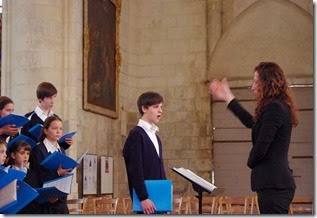 photo by Paterm
What if you think you’re up to the job but lack the confidence to step forward? Here are some ideas that might help.
A concert is coming up and your choir leader decides it would be great if the last verse of one of your songs was sung by a quartet with one singer from each part. It’s one of your favourite songs and you know it inside out.
But when she asks for volunteers to try out, your mouth goes dry, your heart starts to beat faster, your palms get sweaty and you find it hard to breath. You’d love to step forward, but by the time you’ve plucked up the courage, somebody else has beaten you to it.
How can you find the courage next time to step up? Here are seven ideas that might help.1. the usual suspects
When I ask for volunteers in my own community choir, there is a small group of singers who are usually the first step forward. The trouble with this is that the other singers then feel that they can’t try out. The solution is for your choir leader to quietly ask these particular singers to not always step forward, or to make sure that they’re not always in the running by saying “Let’s try someone else for a change.”2. not in front of the others!
Although you’ll end up singing in front of the rest of the choir if you’re chosen, at the trying out stage it can be terrifying. Ask your choir leader if try outs can be held privately. It can also be daunting to actually volunteer in front of the choir, so you might want to have a private chat with your choir leader to say that you’d be interested in trying out next time there’s an opportunity. Declaring your interest in this way is a kind of commitment which may help to push your forward when the time comes.3. find a friend
If you’re trying out for a small ensemble, find a friend (or friends) from another part and agree to volunteer together. Safety in numbers (and the familiar)! You might even want to practice at home together beforehand.4. ask for a workshop
To give everyone who wants to try out a fair chance (and to develop skills within the choir) ask your choir leader if they’re prepared to run a workshop looking at small group and solo singing skills. This will be a chance for more choir members to see what it feels like to sing a part on their own in the relative safety of a workshop. If they find they can do it confidently, it will be easier for them to volunteer in the future.5. what’s the worse that can happen?
Many singers lack the courage to step up and try out. They get stuck inside their head worrying about if they’re good enough, the embarrassment of getting it ‘wrong’, what the other singers will think of them, whether their voice will crack or if they’ll run out of breath. This happens to everyone.
You’re putting yourself on the spot so it’s inevitable. But it’s precisely because of this that the rest of the choir will be behind you. It’s a team game and they’ll want to you to succeed (it means they won’t have to do it!). If you dry up or your voice cracks they will empathise and be encouraging (they’ve all been there themselves).6. not getting the part doesn’t mean you’ve failed
If you do find the courage to try out, but don’t end up being chosen, don’t despair, there’s always the next time. It doesn’t mean you’re a ‘bad’ singer or not as ‘good’ as another singer – it just means that you weren’t the right person this time (which may have to do with the quality and timbre of your voice in this particular context).
Next time you’ll be singing a different song with different singers and may well fit in perfectly. Or it might be that you simply need a little more singing experience so when the next opportunity comes round in a few months you’ll be ready.7. question your motives
Some people give themselves a hard time when they don’t find the courage to step forward. And some even give themselves a hard time when they DO step forward (maybe too often). If your motive is to show off, or to prove to yourself you can do it, or to be famous, or attempt to be better than the other singers ... then maybe you shouldn’t be doing it.
You should only step forward if you love the song, love singing solo or love singing harmony in a small group.Chris Rowbury
Website: chrisrowbury.com
Facebook: Facebook.com/ChrisRowbury
Twitter: Twitter.com/ChrisRowbury
Read more ...
-
Language Weekend
Listed on May 10, 2015 by Benslow in Blogs!Are you going on holiday this year? Want to learn enough of a language to “get by”? Then our brand new Language Weekend may be for you! It is also the perfect opportunity for any of your non-musical friends, colleagues or family to try the Benslow Music experience.Read more ... -
The challenges of running a drop-in singing group (and why you shouldn’t start one)
Listed on May 4, 2015 by Chris Rowbury in Blogs!Some people run ‘drop-in’ singing sessions. People can drop in on any session they want, there is no commitment and no signing up for a ‘season’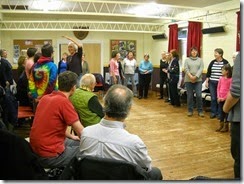
It’s a nice idea: no commitment, no pressure, all very fun, sociable and informal. But there are plenty of good reasons why groups like this are hard to sustain. Here are ten of them.
Most choirs and singing groups:- meet on a regular basis (usually weekly);
- have a rehearsal of between one and two hours;
- have a core of members who attend for many years;
- run in blocks of sessions (called ‘seasons’ or ‘terms’);
- ask singers to commit to a season at a time (often by asking for payment in advance);
- have a public performance at the end of a season.
But there are also ‘drop-in’ groups where singers can attend as many or as few sessions as they like. These groups:- usually meet on a regular basis (weekly or monthly);
- have sessions of between one and two hours;
- have singers who attend irregularly for a few months, then drop out;
- tend not to bunch sessions into seasons;
- do not ask singers to commit themselves to a given number of sessions (people pay when they attend a session);
- seldom have any kind of public performance.
As far as the leader of a drop-in group is concerned, there are many challenges not encountered in a regular choir. Here are ten of them.- different singers each time – hard to create a cohesive group and for singers to get used to singing with each other (see also It’s summer – where have all the choir gone??!!).
- no on-going development – hard to build on vocal technique and ensemble training from session to session. This leads to always teaching to the lowest level of experience in the room. Nobody benefits.
- new songs every time – you can’t assume that those singers who came last time will be there the next time so it’s easiest to teach brand new songs each session.
- can’t do complex material – the songs you teach can’t be too long or complex as they need to fit into a self-contained session.
- no idea which voice parts are going to turn up – hard to decide which arrangements to do if, for example, no tenors come to a particular session or it’s all sopranos.
- lack of commitment can affect attendance – if a singer is committed to a group (like a choir) then they have a sense of allegiance to their fellow singers and might overcome a slight cold or a rainy night to attend. But in a drop-in group there is no such allegiance and if a sunny day beckons it might mean that singers decide to stay in their garden instead.
- easy to forget when sessions are – some groups meet every fortnight or the second Saturday of each month. It’s very easy to lose track of when the next session is.
- fluctuating income – for the person leading, there is no way of knowing what their income will be for any given session, so hard to plan and budget.
- hard to work towards performance – if the drop-in group decide that they would like to perform, then it’s difficult to organise sufficient rehearsals where everyone can attend.
- other demands on people’s time – many drop-in groups meet on weekends, unlike most choirs which are on a weekday night. Weekends are when there are most demands on people’s time.
It’s not impossible to overcome these obstacles, and there are some successful drop-in groups out there (do let me know if you are in one!). But it can be much harder, more frustrating and limiting to run one of these groups than a regular choir.Chris Rowbury
Website: chrisrowbury.com
Facebook: Facebook.com/ChrisRowbury
Twitter: Twitter.com/ChrisRowbury
Read more ...
-
Office Closure
Listed on May 3, 2015 by Benslow in Blogs!The Benslow Music offices will be closed from 5pm on Monday 4 May and will re-open at 9am on Thursday 7 May. Any emails, booking forms or messages received during this period (including online applications) will be addressed on our return.Read more ... -
Viola Day with Richard Muncey
Listed on May 1, 2015 by Benslow in Blogs!*New Course*Fri 3 July 2015Tutor: Richard MunceyRead more ... -
What should individual singers focus on when performing as part of a choir or small group?
Listed on April 27, 2015 by Chris Rowbury in Blogs!Whether you sing harmony in a small group or a large choir there are many things demanding your attention: other singers, conductor, audience, your own part, remembering lyrics, sheet music, and so on. photo by andercismo
But what is the most important thing to focus on? It turns out that there are several.
When we perform as singers in a group, there are all sorts of things we have to focus on. The worst thing we can do is to “zone out”, get totally lost in the music and start daydreaming.
At first it can all seem overwhelming, rather like when we first learn to drive a car. But over time it is possible to leave some things to our subconscious and put all our energy into focusing on the important things.
None of this is rocket science, but it’s all too easily forgotten in the excitement of live performance.
Here’s a reminder of the important elements.inside vs. outside
To perform effectively as part of any harmony singing group – whether it’s a trio or a 100-voice choir – we need to focus both inside the group and outside the group.
Our inside focus needs to be both within our part (if there are several singers on each part) and between parts. We need to be aware of blending our voice, balancing volume (both with other singers and with the other harmonies), keeping time (and making sure we are matching the rhythm of the lyrics with the other singers).
Our outside focus needs to be on the audience: communicating the meaning and feeling of the song, connecting with audience through eye contact and engagement, projecting sufficiently to be heard properly and also on the conductor (if we have one).
Studies into so-called ‘multi-tasking’ have shown that we are actually very bad at it. We are not truly able to focus our attention on several things at once. What we do is shift our attention quickly between each thing that demands our focus.
So we need to constantly and quickly shift our focus between inside and outside.
It’s very easy to forget this and to choose just one thing to focus on (e.g. watching the conductor like a hawk or pleasing the audience) in which case the other elements will begin to suffer (e.g. tuning or timing or balance).ears vs. eyes
Many choirs use sheet music or lyric sheets in performance. However, we live in a very visual culture and it’s all too easy to get our heads stuck in our books.
I might know the lyrics to a song inside out and have sung it for years, but as soon as you put the lyrics in my hand, I will start to look at them and find it hard to look away.
The most important sense when singing harmony in a group is our hearing. But it’s very easy to forget this when we have something to look at (audience, conductor, sheet music, lyrics).
So like the inside/ outside focus shift outlined above, we need to constantly shift our focus between our ears and our eyes with a definite bias towards our ears.focus of attention in rehearsal
In performance we constantly shift between inside and outside and between ears and eyes. After a while these shifts become second nature. Things only become problematic when we get stuck with our focus on just one thing to the exclusion of other, equally important elements.
But in rehearsal we can be directed to focus on a single element in order to refine our group singing or to work on particular aspects of a song. For example, your choir leader might ask you to focus on volume the first time through, but then the blend or enunciation the next time through.
This is fine as a rehearsal tool, but there is no way that you can focus on all these different elements in performance.
When you come to perform you need to trust that the fine detail work has been done and not try consciously to apply any of the specific work you did in rehearsal.
You just need to remember inside/outside and ears/eyes.further reading
You might also find these other posts of interest.
Singing is all about listening
10 exercises guaranteed to get your singers listening more carefully
Singing in harmony – small group skills
Singing in a choir – balancing individual freedom with the demands of the teamChris Rowbury
Website: chrisrowbury.com
Facebook: Facebook.com/ChrisRowbury
Twitter: Twitter.com/ChrisRowbury
Read more ...
-
First Lines – Ben Bradfield’s Arvon Week
Listed on April 23, 2015 by Arvon in Blogs!Ben Bransfield, teacher of English at King’s College School in Wimbledon, introduces sixteen boys to their first Arvon...
The post First Lines – Ben Bradfield’s Arvon Week appeared first on Arvon.
Read more ... -
10 great reasons why all men should join a choir – now!
Listed on April 20, 2015 by Chris Rowbury in Blogs!Being in a choir is great (see The pleasures of being a choir member), but most mixed choirs never seem to have enough men.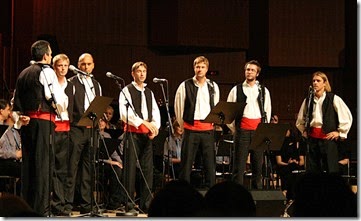 photo by Roberta F.
Here are 10 very good reasons why every single man out there should join a choir as soon as they possibly can. Use the hashtag #getmensinging on social media.10 reasons why all men should join a choir
- be needed
Manly voices add depth to any song, especially songs from Africa. You don’t need many male singers to make a huge difference to the sound of a mixed choir.
- make new friends Being part of a choir is a wonderful social activity. There are plenty of opportunities to meet new people (maybe even new life partners!) who have similar interests.
- live longer
There are plenty of scientific studies now that show how good singing is for the health, but not just any old singing, singing as part of a choir: it’s a stress-buster, helps with breathing problems, puts you in a good mood, reduces blood pressure, prevents social isolation, sharpens the brain, and much, much more.
- be part of a supportive community It’s extraordinary how quickly a choir becomes a real community. There are plenty of stories of how supportive other choir members can be at difficult times: bereavement, relationship break-ups, bad health, loss of job, etc.
- become more attractive Women go weak at the knees when they hear men singing! You’ll be amazed at how attractive you become when you start singing. And other men will be seriously impressed by your manly voice – whether high or low – and will look on in envy and admiration (and wish they’d joined the choir too).
- find your singing voice
If you’ve not sung much before, being in a choir is a great way to explore your singing voice in a safe space without being put on the spot. You are one of many and can hide at the back until you find your voice and feel more confident.
- show off to friends and family Once you’ve joined a choir you will soon want to share the amazing songs with your friends and family. Show them what you’ve been up to and bask in their pride and admiration.
- let off steam
What scope is there in everyday life to scream at the top of your voice without causing trouble? Singing in a choir is a fantastic way to let off steam in an acceptable way. Sing at the top of your lungs and let all your worries and frustrations go.
- have fun You’ll be surprised how much laughter goes on in choir sessions. Yes, you might have to work a little to learn the words and get your part right, but above all, singing in a choir is FUN!
- cure baldness Everyone knows that singing in a choir cures male pattern baldness. If you see any bald men in a choir, it’s because they didn’t join young enough!
further reading
You might find these other posts of interest too.
Singing: what a difference a man makes!
Men and singing (a series of three posts)
Everybody has a place in the choir
The problem with men: getting them, handling them, keeping themChris Rowbury
Website: chrisrowbury.com
Facebook: Facebook.com/ChrisRowbury
Twitter: Twitter.com/ChrisRowbury
Read more ...
- be needed
-
Jim Hinks’ Arvon Story
Listed on April 14, 2015 by Arvon in Blogs!Before I was a publisher, I worked as a plasterer. Plastering often coincides with change: people moving into...
The post Jim Hinks’ Arvon Story appeared first on Arvon.
Read more ... -
How to encourage regular choir attendance – balancing fun with commitment
Listed on April 13, 2015 by Chris Rowbury in Blogs!Lately I’ve been wrestling with the problem of inconsistent attendance at choir. If not everyone comes each week it’s hard to do any development work and it means I have to keep teaching the same songs again and again.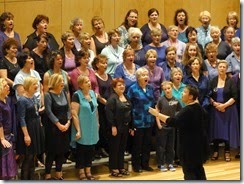
Jane Christie-Johnston from Tasmania contacted me recently and we had a bit of an email chat. I asked her how she dealt with the challenge, and this post is based on her reply.
Jane Christie-Johnston is the Director of Sing For Your Life! Choir in Tasmania. Jane has watched her choir grow from about 12 to around 150 singers in almost 10 years. As you can imagine this has brought many challenges and new adventures.
Here is what she has to say about the challenges of maintaining regular attendance and how to keep a choir fresh and exciting over the long term.
Firstly, before I rant about some of the challenges, I have to stress that I love my choir. LOVE. With a passion. I couldn’t do it for nearly ten years if I didn’t love it and the singers within. But of course with any group, particularly a group that has grown so much and so quickly, there are challenges along the way.
I often have the same thing going on in my choir in relation to sporadic attendance. It’s extremely hard to walk the middle ground between creating a fun, laidback, pay-as-you-go, welcoming choir which people can fit into their busy lives, and creating a committed group which strives to be its best, performing where possible and engaging audiences by being polished and rehearsed.
In our choir we always stress that we understand that ‘people have lives’, and that singing in a choir is just one part of a busy life ... but that can be a double-edged sword for me in that it’s harder to build the ‘core strength’ of the choir when so many members are drifting around the edges.
I have about 150 choir members, but each week between 110 and 130 come to rehearsals, across two rehearsal groups (I do the same thing at both rehearsals each week so people can pick and choose, swap around, come to one or two or none etc.). So we, like you, have a slightly different group each week, and there are always at least a few people looking a bit anxious or working hard to catch up on some foreign words we’ve gone through in detail the week before.
Here are some things I’m doing to try and shift the situation. I acknowledge that these things are easier to do with a large group, because even if quite a few choose not to participate regularly, I still have a wonderful, large core group to work with. As with anything, progress can be slow!1. singers need to do the work if they want to perform
I try to make it clear (on the website and at rehearsals) that performing is optional, but that if people want to perform it becomes a lot more important for them to know the words, their parts, the songs, how to follow my conducting, and the ‘performance’ version of the song (e.g. beginnings and endings). Over many years I’ve continued to build an expectation that those who want to perform will put in the extra effort.2. don’t feel you have to go over the parts week after week
I don’t spend too much time going over parts week after week. I try not to leave anyone struggling and feeling really lost, but apart from ironing out some wrinkles here and there I won’t go through a song/part from scratch if we’ve been singing it for a month already. It’s just not fair to the members who are putting in the time and effort.
If someone misses several weeks and really can’t catch up, he/she needs to either find a way to catch up individually (with the help of me or a fellow singer) or, if that’s too hard, maybe postpone their involvement in the choir and come back the following year when I’m teaching new songs, and when they might have more time to commit. People soon get the message that, even though coming to choir shouldn’t be an arduous task, they do need to give it a little bit more effort and regular commitment.3. ‘informal’ doesn’t mean it’s a social club!
I used to refer to our choir as an opportunity for a ‘social sing’, but really, we’re more than that, and the language around ‘social singing’ isn’t reflective of what we’re actually trying to do. It’s informal, and laid-back, but it’s not just a social get together once a week; we have a bigger purpose than that.4. have a sensible policy on when new singers can join
Over the years I’ve slowly been shifting the ‘rules’ (more like guidelines/expectations - nothing is very regimented) around joining the choir. It used to be that people could join any old time (our choir year usually runs Feb-Nov) which meant that I literally had people joining three or four weeks before our big end of year concert, where we were singing a dozen or so songs in four-part harmony.
These days it’s quite clear on the website that we welcome new members up until around August (we conveniently have a singing festival in our city each July - this brings a new wave of members who have seen us perform). After August I tell people that they need to wait until the following February, when the year starts up and I start teaching a new program of songs (everyone, old and new members, learning together). A few will still join but it’s very much a ‘sink or swim’ situation!5. have catch-up days for new members
In September last year I ran a ‘choir catch-up’ day for new members (those joining after July) and for anyone who felt they needed to polish up some of the songs. I used a whole day to go through all the parts of most of our repertoire, starting with the song I felt needed the most work and working down through the less certain or more difficult songs, so that those members could go back to regular rehearsals feeling more prepared for the lead-up to the end of year concert.
This meant that I didn’t have to re-teach songs at choir that some people had been singing for more than six months. It’s good to boost the catch-up day with some regular choir members so new members don’t feel totally stuck out on a limb learning new things in a small group - quite terrifying for some of them!6. don’t spoon feed too much
I stopped printing and handing out song lyrics. We’ve never used any sheet music in the choir but I used to produce documents full of song words. People are now much more comfortable trusting their memories and if they need to make notes to help them remember, it’s their responsibility to do this. Some choir members continue to struggle with this, but I love seeing people’s happy faces rather than the tops of their heads while their noses are stuck in folders every week, so I tell people to bring a pen and notepad, or type words into a phone.
I was finding that people would take the song words home, make a few notes about their parts, and that meant they “knew the song”. Three weeks later they’d come to rehearsal and get a rude shock at how far the song had progressed, or that there was a vamp added, or a variation to a chorus etc.7. it’s up to the singers to make sure of their parts
I tell people all the time that if they’re not sure about parts, either because they join the choir late in the year or they miss a lot of rehearsals, they’re welcome to bring along a phone or recorder and I’ll sing their part for them, so they can listen and practise at home. Although I spend quite a few coffee breaks singing into phones, it’s a great help to people. I do tell them that this is to supplement their learning in person at choir, NOT to replace it!8. it’s hard to get singers to come on cold, dark nights
Tasmania has four distinct seasons and winter is cold, with very short days (getting dark by 4.30/5pm). My friends who are choir leaders all have the same story – choirs sometimes literally halve in numbers through winter, people get home from work and don’t want to go out again, or cold and flu bugs might take hold and spread through a group. Revving everyone up again during/after winter has traditionally been VERY hard.
The Festival of Voices in July has shifted this wonderfully. We now have a mid-winter event that is one of the highlights of our performing year, and attendance throughout June is at an all-time high. We perform around the city during the Festival week, then we have about three weeks off, a perfect time for recovery, rest and hibernation, and in August we all come back with renewed energy, with our last wave of new members for the year.
(Chris: interesting that we in the Northern Hemisphere seem to have the opposite problem: attendance during the summer months is very sporadic as people go on holiday or spend more time on their allotments! Winter is traditionally a time for people to start new adult education classes and January brings a flush of enthusiasm for new hobbies as people make New Year resolutions.)9. create milestones to give singers something to work towards
I give them milestones to reach - performances, generally. I try to be clear about my expectations regarding what they need to know to perform. I have a couple of big milestone performances reasonably early in the year, then the Festival of Voices in July.
If these milestones don’t come along naturally then I create them. Last year I ran a big social ‘Sing For Your Supper’ event, where I got the two rehearsal groups together. We sang all the songs we’d learnt so far that year, and many members were amazed by the combined sound after only singing with one rehearsal group for so long. Similar milestones could be something like having an open rehearsal where you invite families and friends to come and listen, share supper, etc.
Next year I’m taking 70 of our singers to Ireland for the Cork choral festival - and travellers have signed a commitment to be regularly-attending in 2015 and that they will know all this year’s songs by the end of the year, in preparation for the trip. This has been a wonderful incentive to maintain regular attendance! ... maybe you should sign your choir up for the Tasmanian Festival of Voices in 2016 ... ??!!10. make sure you create a lively social programme
I oversee an informal social program each year so that people have a chance to feel connected beyond just rehearsals - with connection comes a greater sense of teamwork. Social events are entirely optional but we have a pretty good attendance rate. We’ve had Sing For Your Supper events, trips to the movies, karaoke nights, a sing-along Sound of Music movie night, picnics and barbecues. Most of the organising is done by one of our choir members who just loves to organise things - every choir has one (usually many) of these wonderful people. We sell tickets to events at choir sessions only, so that if someone wants to come to the karaoke party they have to be actively attending rehearsals to buy a ticket.
We also have informal activities as part of our choir sessions usually during the mid-rehearsal tea-break. A few times a year we run things like swap-nights for books, DVDs, CDs, cookbooks, etc., and they’re great fun (and free!).11. give regular pep talks and emphasise that choirs are communities
I try to give good pep talks and to keep things relatively light-hearted and humorous in front of a group even when they’re working hard. I work hard to outline expectations, shut down poor behaviour, rev people up, show that I’m excited about the sound and our songs, and give positive reinforcement. I’m not shy about telling the group that something needs work, and I’ll share my vision for performances or events. I often tell them what I imagine a song will sound and feel like in a performance, and why it’s so important for them to learn it properly, and to be patient and kind during the learning process, etc.
For many years I’ve used the phrase ‘Choir = Community’, in newsletters, in interviews I do about the choir, and at choir rehearsals. I tell people that being in a community choir isn’t just about the individual. I get them to look to their right, their left, in front and behind - and I tell them that their responsibility stretches to those around them, both in the room and beyond. This becomes increasingly important for performances. The essence of teamwork is always remembered, so to not turn up is to let your team-mates down.12. if you don’t know the song, don’t sing it!
I would NEVER target someone individually in front of others about his/her singing, and with so many of my members having bad singing/choir experiences at school or church I’d never suggest to someone that he/she shouldn’t be in the choir, or should mime at the back etc. But I will quite happily stand in front of the choir before a performance and say to the group, “if you’re not 100% certain that you know your part for a particular song, don’t sing it”. I’m clear that if that means they have to mime a line every now and then, that’s better than coming out with something dodgy and unrehearsed and wrong.
I don’t see why someone should miss a whole performance if they’re shaky on just one or two songs, but that doesn’t give them an invitation to just sing anything they think might fit for those songs - they need to respect the group and the overall sound, and the arrangements that have been written (no making up parts on the run!!). To date no-one has had a problem with this, and we talk about it with humour despite it being a serious subject.13. work gradually towards your ideal choir
As hard as it is (I’m a perfectionist from way back) I give them, and myself, a break. The choir is a product of what I’ve set up – we’ve always been very relaxed and informal and any shift of those goalposts needs to be gradual. I can’t expect them to suddenly care more about things that haven’t mattered for years – if I switch to being really pedantic about things that may matter in a more serious or auditioned choir, I know that our membership would drop significantly. It’s important for us to remember the big picture and all the reasons we sing together, while still working gently for continuous improvement.14. work out what you want and stick to it
So, Chris ... after all that rambling, I think the bottom line has to be “it is what it is”. Outline your expectations, stand by them, and keep doing what you’re doing. Whatever you do will find the right market. Work out what your personal deal breakers are (they’ll be different from mine) and stomp on anything that crosses the line. I know from your writing that you feel that way - at the end of the day, as you’ve written previously, you can’t keep everyone happy. If you’re clear about what you offer and what you expect, including attendance and performance standards, your audience/market/team will form around you – and very importantly, you will be true to yourself as well as those in your lovely choir.
Jane Christie-Johnston
Director, Sing For Your Life! Choir
choir@tadaa.com.auChris Rowbury
Website: chrisrowbury.com
Facebook: Facebook.com/ChrisRowbury
Twitter: Twitter.com/ChrisRowbury
Read more ...
-
OPEN PAINTING BREAK 30 April- 4 May
Listed on April 11, 2015 by Shorland Old Farm in Blogs!Come and relax on a four-day painting break, in the glorious Exmoor countryside, and paint/draw your own thing in the company of other painters. £296 per person single room / £248 per person shared room. Includes four nights’ accommodation, full English breakfast, and three-course dinner, plus unlimited tea/coffee/biscuits all day. To find out more, call ...
The post OPEN PAINTING BREAK 30 April- 4 May appeared first on Shorland Old Farm.
Read more ... -
Pass it on
Listed on April 8, 2015 by Arvon in Blogs!Virginia Macgregor, English Teacher at Wellington College, blogs about a school week at The Hurst, Monday 30th March –...
The post Pass it on appeared first on Arvon.
Read more ... -
5 good reasons why joining a choir might not be right for you
Listed on April 6, 2015 by Chris Rowbury in Blogs!We all know that joining a choir is a good thing to do. But it might not suit everyone.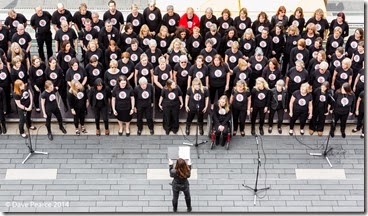 photo by Dave Pearce
Here are five reasons why it might not be such a good idea for you.
If you are a singer who agrees with any of the following, then joining a choir might not be right for you.
1. “I love to just belt out loud”
Singing in a choir is about blending in with others so you won’t often get the chance to belt out loud unless the whole of your section is instructed to do so.
2. “I get put easily off when someone sings a harmony to what I’m singing”
Most choirs sing in three- or four-part harmony so it’s inevitable that there will be people singing different harmonies at the same time as you.
3. “I enjoy making up my own harmonies”
Unless it’s a very small choir which specialises in improvisation, the majority of choirs will expect you to learn harmonies that are set and have been worked out in advance by somebody else.
4. “I don’t like commitment”
Although it doesn’t have to be a huge commitment, being in a choir will entail regular attendance and commitment to being at rehearsals if the choir performs.
5. “I want to be a famous singer”
Choir singing is a team game and not a solo sport. Singing in a choir can certainly get you started on a singing career, but it’s not a suitable vehicle for fame.
If you still think being in a choir might suit you, check out How to be a good choir member to see what will be expected of you.Chris Rowbury
Website: chrisrowbury.com
Facebook: Facebook.com/ChrisRowbury
Twitter: Twitter.com/ChrisRowbury
Read more ...
Take a look at ...
-
Anglia Leisure Learning
Anglia Leisure Learning offer a range of weekend residential and day courses at carefully selected venues, mainly in the East of England.Read more ...
-
Promoting residential lifelong learning in the UK since 1983

-
Blogs! | LeisureCourses.net - short courses & residential study breaks in great locations - Part 5
A selection of articles from bloggers within the LeisureCourses.net community


Learning for Leisure
List Your Details
Quick Links
Further Information
Back to Top ↑
LeisureCourses.net 2015